1.11.0
Date: 2026/11/16
General
nmaas 1.11.0 is a milestone release including central variable storage, application bundles, extended permissions for group managers and several improvements to application deployment, webhook and remote cluster handling.
nmaas 1.11.0 is deployed using version 2.1.0 of the nmaas Helm chart. Please review the Helm chart changes before upgrading, in particular the changes to the Postfix configuration.
New Features
Central variable storage
System and domain level variables can now be defined centrally and used as values in application deployment specification parameters, with domain level values taking precedence.
Application bundles
Added support for application bundles, which can be composed of multiple applications with a title and description.
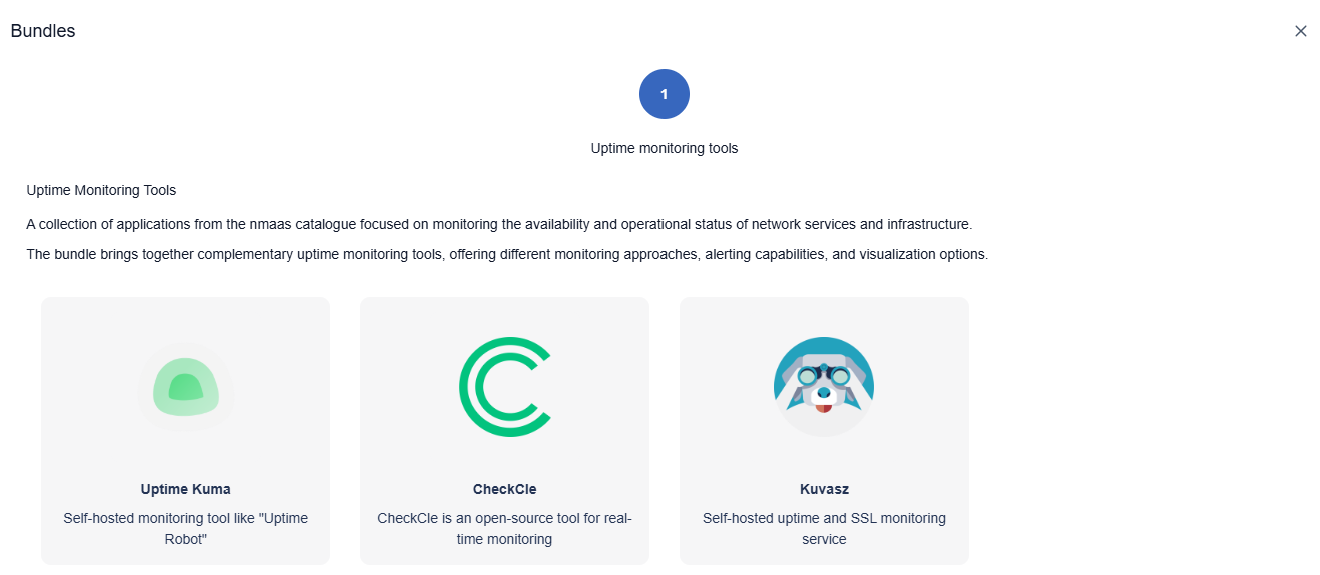
Update of release values without redeploying
Application instance configuration can now be updated by executing a Helm upgrade command with new values, without the need to redeploy the application.
Extended permissions for group managers
Group managers can now add, edit and delete individual domains, manage resource limits on group level, update domain technical details and annotations, and access domain users and details.
Admin dashboard with detailed domain group activity logs
Added a new dashboard displaying detailed logs of activities within a domain group.
Enhancements
Templates for webhook content
Webhook request content can now be generated from templates, with webhook history storing the actual body sent.
External kubeconfig support
nmaas Platform can now run using an external kubeconfig file for central cluster management, and edited kubeconfig files of remote clusters are persisted to the file system.
Improved remote cluster management
Added endpoints for retrieval of complete remote cluster information and filtering of application instances deployed on a given remote cluster.
More advanced configuration passed as Helm install values
Nested JSON objects can now be passed as additional parameters from the deployment wizard to the Helm install command, with all arguments persisted.
Application state history improvements
History entries now include information about the user that initiated each state change.
REST API security improvement
Requests with an invalid authorization header now return a 401 response instead of a 302 redirect.
Platform and dependency upgrades
Upgraded nmaas Platform to Java 25, Kubernetes client to version 8 and other supporting dependencies.
Bug Fixes
Fixed display of the UUID token
Corrected the value returned for the user access UUID token.
Helm chart changes
The chart ships the following component versions:
| Component | Version |
|---|---|
| nmaas-platform | 1.11.0 |
| nmaas-portal | 1.11.0 |
| nmaas-platform-populate | 1.11.0 |
| nmaas-mcp-server | 1.2.0 |
| nmaas-postfix | 2.0.0 |
Upgrade notes
Required actions:
- If
postfix.image.repositorypoints to thenmaas-postfix-smtpimage, orpostfix.image.tagis set to a1.xversion, remove these overrides. Installation and upgrade fail with an explanatory error until they are removed. - If mail is relayed through an upstream SMTP server, set
postfix.properties.smtp.enabled: true. Note that TLS towards the upstream server is mandatory.
Behaviour changes:
- If
postfix.properties.hostnameis not set, the Postfix hostname changes frommailer.example.comtomailer.<global.nmaasDomain>. - The nmaas MCP server is now disabled by default.
Optional cleanup after upgrading:
- The
nmaas-helm-key-privateandnmaas-helm-key-publicSecrets are no longer used and can be deleted. - If mail is not relayed through an upstream SMTP server, a manually created
nmaas-smtp-secretSecret is no longer used and can be deleted.
Details on each change are provided below.
nmaas MCP server disabled by default and version pinned
The nmaas MCP server is now disabled by default (mcp.enabled: false). It authenticates to nmaas Platform with an nmaas Platform API token, stored in the nmaas-mcp-secret Secret, which can only be obtained once nmaas Platform is running. To enable the nmaas MCP server, create the nmaas-mcp-secret Secret (or set mcp.properties.nmaasPlatformToken.literal) and set mcp.enabled: true.
The nmaas MCP server image is now pinned to version 1.2.0 instead of tracking the latest tag, making deployments reproducible.
Fixed nmaas Platform startup on fresh volumes
On some storage classes, a freshly provisioned nmaas Platform volume is owned by root and is not writable by the non-root user (uid/gid 1000) the nmaas Platform image runs as. The platform could not create its log directory and was stuck in a crash loop on first startup.
The chart now:
- sets a pod security context with
fsGroup: 1000(platform.podSecurityContext), so the volume is group-writable by the nmaas Platform user. With the defaultfsGroupChangePolicy: OnRootMismatchownership is only changed recursively when the volume root does not already match, which also repairs volumes of existing deployments affected by this issue; - runs an
init-directoriesinit container (platform.initDirectories) that creates the directories used by nmaas Platform on the volume before it starts, and fails with a clear error if they are not writable.
Deployments that used the manual workaround (creating /nmaas/files/log from a temporary pod) do not need to take any action.
Postfix hostname derived from the nmaas domain
postfix.properties.hostname no longer defaults to the placeholder value mailer.example.com. It now defaults to an empty value, in which case mailer.<global.nmaasDomain> is used. Postfix uses this hostname as its own identity and, unless postfix.properties.smtp.fromAddress is set, in the sender address of all outgoing mail (no-reply@<hostname>), so it should be a hostname within a domain you control.
Existing deployments that did not explicitly set postfix.properties.hostname will switch from mailer.example.com to mailer.<global.nmaasDomain> after upgrading. To keep a different value, set postfix.properties.hostname explicitly.
New nmaas-postfix image
The nmaas-postfix and nmaas-postfix-smtp images have been merged into a single nmaas-postfix image, version 2.0.0, based on Alpine 3.24 with Postfix 3.11 and available for both linux/amd64 and linux/arm64. Postfix now runs directly in the foreground and logs to standard output, without supervisord and rsyslog.
The Postfix deployment now has readiness and liveness probes (postfix.readinessProbe, postfix.livenessProbe), which check that Postfix is listening on the submission port.
The image fixes a mail loop: Postfix rewrote the sender of all messages, including bounce notifications, to no-reply@<hostname>, so a bounce notification that could not be delivered was bounced again, endlessly, which could lead to CPU and memory spikes. Bounces addressed to the sender address are now discarded and only logged.
Relaying through an upstream SMTP server is now enabled with postfix.properties.smtp.enabled instead of switching to the nmaas-postfix-smtp image:
|
When relaying is enabled, TLS towards the upstream SMTP server is mandatory, as it was with the nmaas-postfix-smtp image.
postfix.properties.smtp.fromAddress now defaults to an empty value, in which case no-reply@<postfix.properties.hostname> is used. The SMTP credentials and nmaas-smtp-secret are only used when relaying is enabled. Previous chart versions referenced nmaas-smtp-secret even without relaying, so deployments that do not relay mail can delete a manually created nmaas-smtp-secret after upgrading.
Deployments that point postfix.image.repository to the nmaas-postfix-smtp image or set postfix.image.tag to a 1.x version must remove these overrides, and deployments that used the nmaas-postfix-smtp image must set postfix.properties.smtp.enabled: true instead. To prevent deploying a misconfigured mail server, installation and upgrade fail with an explanatory error if postfix.image.repository still points to nmaas-postfix-smtp or postfix.image.tag is set to a 1.x version.
Resource requests and limits for Postfix
A new postfix.resources parameter allows resource requests and limits to be configured for the Postfix container. No requests or limits are set by default. An example configuration is provided as a comment in the default values file:
Removed Helm access SSH keys
The global.helmAccessKeyPublic and global.helmAccessKeyPrivate parameters have been removed. The SSH key pair they referenced is no longer used by nmaas Platform, and the corresponding Secret objects no longer need to be created before installation. The installation guide has been updated accordingly.
Existing deployments can safely delete the nmaas-helm-key-private and nmaas-helm-key-public Secrets after upgrading to this chart version.